Monday, 16 December 2013

Conventions of the Thriller Genre

The Thriller Genre...

             
Recently, I have been noticing certain characteristics and traits that seem to always be present in films in the Thriller genre. These are called conventions of the Thriller genre. The reasons that they are usually present it because they always succeed in creating specific effects on the viewer. Hence, the director can then utilise a few of these conventions to have an effect on the viewer. This effect can then be played on to scare the viewer or get them excited etc...

             To know why a certain trait has been adopted as convention of a genre, I should first understand what the genre in question 'is'. I need to know why a film is a thriller and not a romcom. The Thriller genre fits an interesting niche because it seems to fit between action and horror, with elements of both. Thriller is defined as a film the uses suspense, tension and excitement as its main elements. They very often play with the viewers emotions to achieve an effect on the viewer. It is usually a Villain driven plot, the story being pushed forward by the act of the antagonist rather than the protagonist.
             One of the most common effects that's used in Thriller films, and films in general, is to use music to build tension as well as to release it. Psycho, the film I first analysed, uses this extensively in it's murder scenes. There is a long near silence to build the tension with a large crescendo of string instruments to then release it as the murder happens. This also works both ways as a total silence can build tension as well as 'letting it sit'. This means not building any more tension but not letting it diffuse away. When used correctly its a very effective mean of keeping the viewer engaged.
             Conventions can quite often relate to the plot. Thriller films tend to have a crime at the centre of a plot. This convention is often used because a crime itself is thrilling, but it is also a feasible starting point for the protagonist to
 then get into these thrilling situations. The themes presented in thrillers tend to be similar such as identity and mirroring. These are all effective themes to be in a thriller film to bring out the desired emotions of the viewer because of how the human mind wants to learn and know the truth. So when an identity is thrown into mystery, we naturally want to know who the person is and why this has happened. This then allows the plot to talk interesting, thrilling and sometimes scary twists.
             The story of Thriller films tends to be experienced from the point of view of the protagonist, therefore several conventions of the genre relate to the protagonist, such as how he acts; how others react to him or can be as subtle as the opening credits reflecting his psychological state. There is almost always an flaw that, for the majority of the film, remains unknown to the viewer. However, the antagonist does know this flaw and does exploit it. Thus putting us as the viewers and the protagonist 'on the back foot'.

             These conventions are important to note because of how often they appear in the Thriller genre and to know why they are there in the first place and what effect they are trying to have on the viewer. I will pay attention to these different techniques and conventions and use them when making my own film. I will try to incorporate some of them in the final piece to produce the desired effect on the audience.

Monday, 21 October 2013

Preliminary

Preliminary Task...
              Before doing main task, I need to make a Preliminary task. This will serve the purpose of showing what I can do at the beginning of the course, which i will then compare too at the end of the course.  I am doing this is a 4 man group (Brad Sanders, Jack Wilson, Sam Yip, Matt Cornes). We all have separate jobs to do, mine is an actor and as a cameraman.


Our set was a TV studio and a stairwell near it. This limited us in what we could do but also forced us to think outside the box in terms of plot and techniques. We finalized an idea of having an unnamed character climb some stair and then lead into and interrogation scene in a very darkened room. This worked because it used easy to access locations and also hid the fact we are using a TV studio  due to it being so dark. We set up a table and two chairs in the set and then positioned cameras and lights to get the desired effects. Despite this there was still some daylight present, we decided we would have to fix this in editing. 


The 4 actors we used were Matt Cornes, Brad Sanders, Eliot Nash and Alex Brown. Matt played the detective. This character was meant to be played as a man with hidden anger. Brad plays the convict. The convict is supposed to be arrogant and sure of himself, having no respect for the detective. The character is refusing to admit to a crime, unknown to the viewer. The guard is played by Eliot. The guard is a subliminal character, as his only role is to look powerful and to push the convict back into his seat when he stands. Alex plays the mysterious case handler, and in this piece his responsibility is to hand the case to Matthew. Overall the filming too approx. two days. The shots were very simple to film properly. Continuity rules were followed and rules such as the 180-Degree rule was followed. We shall now begin to edit this task which i will post later, with a description of what we did as well as having the final product posted there.

Psycho

Film Review...
             While we are filming our Preliminary task we have had to watch and review a thriller film, the one that I was assigned was Psycho by Alfred Hitchcock. Personally I enjoyed this film and took a lot of techniques and ideas away from it. Such as the use of music to build tension and camera angles and shots to highlight objects or to give away characters thoughts and emotions.
             The film surprised me in a few aspects of its story, such as having me think that we had a stable main character in Miss. Crane, until halfway through the movie she is dispatched in it world famous shower murder. This is something that we rarely see in cinema today. Usually there is one main character we follow and a few side characters who are linked to them but almost always are killed of depending on the genre of film. Be it death by gunshot or bloodthirsty shark. It took me by surprise despite knowing that the scene would happen. As a side note, knowing this scene was going to happen took an element of suspense and surprise out of the piece.
            There are 3 main points in the film and plot that I would like to focus on. The first of which is the famous Shower murder of Miss.Crane. It begins with her getting into the shower after leaving a conversation Mr.Bates, throughout this there is a certain sense of tension because of the previous scene in which Bates left a certain bad taste in our mouths due to him talking about his hobbies of taxidermy and evading questions about his mother, the reasons of which become apparent later. After entering the shower, there is a blurry shot of the door opening and a figure entering. We do not see the face of the intruder because of how we only see the shadow of this happening through a shower curtain. This creates the pantomime idea of  'He's behind you!'. This scene is also the first scene which shows the films love of string instruments, with the famous loud violin as the murder takes place. This 'burst' works because of how Hitchcock expertly built tension until it had to explode. This explosion is played off by the sudden burst of noise and quick, yet very important, action.
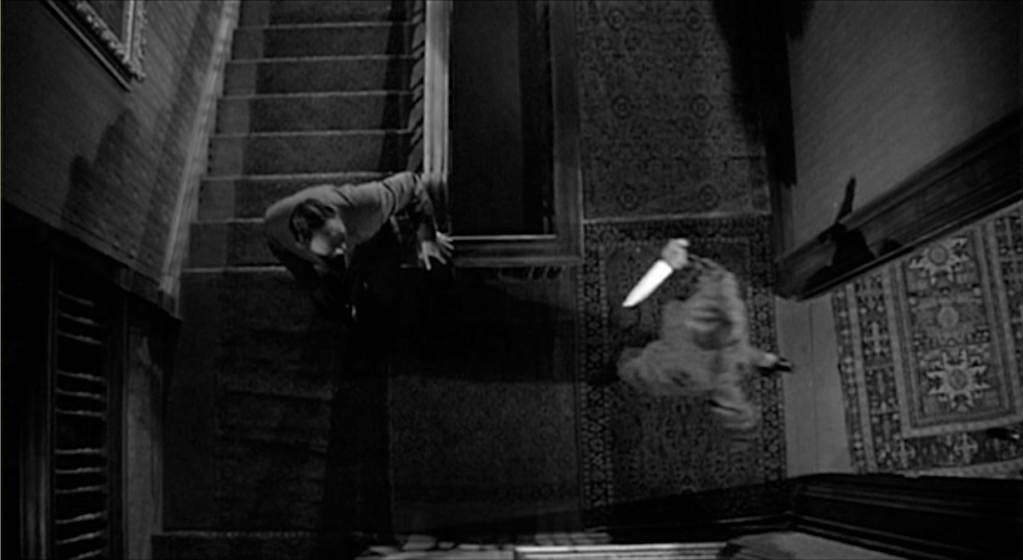
            The second moment I would like to talk about is the second murder in the film, the death of Private Detective Mr. Arbogast. Most of the point I made previously are counted here such as the build up of tension after talking with Bates. Tension this time is built because of how we know that no one is allowed to talk to Bates' mother and that he is trespassing inside of the house. We see him walking up the stairs, step by step raising the tension, until once again and explosion happens. The crescendo of violins and murderer quickly appearing and disappearing.
            The final point that I want to talk briefly about is the explanation at the end. Without spoiling the end, it provided a lot of 'oh yeah' and 'of course' moments and actually makes sense as to why these murders happened. I felt it was a satisfying ending to the film.
             The entire film is shot in black and white due to the technical constraints when it was made. However, I feel that it wouldn't have given off the same vibe of awkward creepiness if it had instead been shot a few years later in Technicolor.
             Hitchcock uses the camera to tell the plot. He shows many important plot points via the camera panning over to it, giving the audience information that the characters don't, making the tension rise because of how we know this information. This is typically called Dramatic Irony. For example, We know about Crane placing the money into the newspaper where as other characters don't.
            In conclusion, I think that Psycho is a very interesting and influential film that I will always keep in mind when moving forward with my own film making. I will borrow aspects such as using camera angles to point out specific objects or places, i will also borrow techniques that were used to build tension such as Dramatic irony (the audience knowing things the characters don't).

Thursday, 3 October 2013

The Specifics

My Specification
             I was given my 'specification' recently. A specification is essentially a paragraph or so about what they expect me to do for each task. Basically the 'specifics' of my course. These are them;

Video
Preliminary exercise: Continuity task involving filming and editing a character opening a door,
crossing a room and sitting down in a chair opposite another character, with whom she/he then
exchanges a couple of lines of dialogue. This task should demonstrate match on action,
shot/reverse shot and the 180-degree rule.
Main task: the titles and opening of a new fiction film, to last a maximum of two minutes.
All video and audio material must be original, produced by the candidate(s), with the exception of
music or audio effects from a copyright-free source. Both preliminary and main tasks may be done
individually or as a group. Maximum four members to a group.

I thought I should post these here in a small post so I know where it is and so you know what is if I ever refer to it.

Sunday, 29 September 2013

Numero 2

Learning Premiere
            We discovered that we will be using Adobe Premiere to edit our work. Now...I have never even touched this thing before, as you may imagine, I was rather intimidated. We were then walked through what this button did and what this symbol meant. Pretty soon I could press play all on my own. I then figured out how to load a video into the program, followed by how to play with the tools to edit pieces of this video. I still couldn't figure out/find the piece of music I wanted to put the video to though...
                  Anyway, the reason we were learning Premiere is because we are going to use it to edit our 'Preliminary Task' (Basically, the 'Before' piece to the 'After', which we will do nearer the end of the course to show how we have progressed)
                  A promising start...


My First Post...

My First Post...
             Right, okay, this is the first post on my new blog. This will be my A-Level Media Coursework folder essentially. These posts will become an archive of my work, what I have been doing and learning throughout the course and how I feel about it. Hopefully, it will become a wonderful kaleidoscope of media. Since this is my first post I imagine it will not be as good as the later ones. Practice makes perfect. Well, lets see how this goes...
P.S I spent about 30 minutes making the blog look nice. I quite like it.